
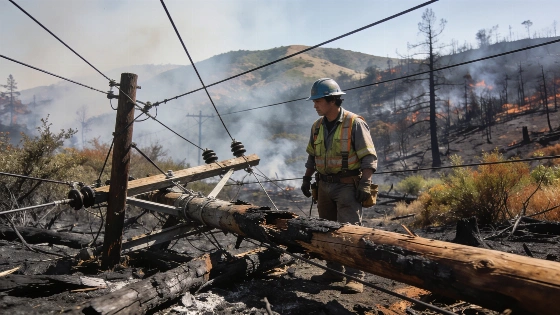
Wildfires are causing more frequent and severe interruptions for power grids worldwide, with nearly 15 million customers losing electricity due to wildfire-related outages since 2022. The International Energy Agency (IEA) reports that these events damage infrastructure and push operators to shut down parts of the grid to avoid further destruction or sparking new fires.
IEA analysts Christine Brandstätt, Inhoi Heo, and Daniel Wetzel point out that almost a quarter of global electricity lines are set to be built over the next decade, much of it in wildfire-prone regions. This growth, along with longer heat seasons and drier weather, leaves electricity networks more exposed to fire risks.
Escalating Economic and Environmental Costs
Economic losses from wildfires in advanced economies have more than tripled since 2014, with insured losses climbing by about 12 percent each year. The United States, Europe, and Australia have seen the sharpest increases. Europe logged its worst wildfire year in 2025, and forecasts for 2026 already top €3 billion in losses. Wildfires also hit local economies, public health, and biodiversity hard, while smoke and environmental damage add to the climate burden.
Electricity Infrastructure Both Victim and Cause
IEA data shows that energy infrastructure sometimes sparks wildfires. In the United States, about four percent of wildfires with known causes since 2000 have been traced to energy infrastructure, and that share is rising. In Victoria, Australia, grid-related safety incidents involving wildfires make up as much as two percent of reports. Vegetation too close to live equipment, faulty hardware, and power lines clashing in strong winds are frequent triggers. Investigations have tied utility equipment to major fires, including the 2025 Eaton Fire in the United States, and utilities in Australia and Greece have faced fines or liability for similar cases.
Federal rules in the United States make vegetation management a formal wildfire-prevention and grid-reliability duty for electricity transmission and distribution rights-of-way. Under 43 CFR §2805.22, operators can remove or trim vegetation during emergencies when trees threaten power lines, as long as they notify the Bureau of Land Management within a day and take all reasonable steps to prevent and suppress fires near rights-of-way. For non-emergencies, vegetation management must follow the terms of the right-of-way grant and any approved operating plan or agreement. The regulation specifically lists pruning or removing vegetation as a way to prevent ignition from electric facilities. A similar U.S. Forest Service rule, 36 CFR §251.51, sets minimum vegetation-clearance distances around power lines and allows emergency removal of trees that threaten service or fire safety. This rule requires clearance to be measured against the line’s maximum operating position, factoring in conductor sag at high temperatures, and links both emergency and routine vegetation work to reliability and safety standards.
Preventive Shutdowns and Grid Instability
To cut fire risk, utility operators are turning more often to preventive shutdowns during extreme weather. In 2025, 21 such shutdowns in North America's Western Interconnection grid affected over 600,000 customers. These shutdowns can destabilize electricity systems, as seen in Argentina in 2023 when a shutdown left about 20 million people without power for a time. Wildfire smoke can also lower solar energy output, with Canadian fires reducing solar photovoltaic generation by up to 40 percent in neighboring U.S. states.
Global Exposure and Response Measures
IEA's global review finds that 22 percent of electricity grids cross areas hit by wildfire conditions at least once every decade, and five percent run through regions exposed every two years. South America has the highest share of above-ground infrastructure in fire-prone zones, while North America has the most total exposed line length. Over 20 percent of at-risk infrastructure sits within 10 kilometers of urban centers, and more than two-thirds is within 50 kilometers. Remote areas make repairs harder, as shown by wildfires in Victoria, Australia, in January 2026 that damaged 900 kilometers of lines, some unreachable for weeks.
In the United States, the regulatory setup creates a trade-off between the urgency of wildfire-related grid upgrades and the need for land-management approvals. Emergency vegetation work can move ahead when there is immediate danger, but routine projects must comply with right-of-way grants, operating plans, and agency approval terms. This affects hazard-tree removal, corridor clearing, and other preventive steps meant to cut ignition risk before fire weather hits. The National Rural Electric Cooperative Association (NRECA) says electric utilities across America are investing billions in wildfire mitigation programs, grid hardening, vegetation management, and advanced monitoring technologies to better protect the communities they serve. In early 2025, the U.S. House passed the Fix Our Forests Act, which aims to speed up federal approval of wildfire-mitigation projects on public lands and would let cooperatives clear hazard trees and vegetation within 150 feet of power lines on federally managed lands, addressing ongoing policy debates over permitting speed and clearance authority.
Strengthening Grid Resilience
IEA experts call for closer cooperation among policymakers, regulators, utilities, and industry to boost grid resilience. They recommend tougher equipment standards, better vegetation management, rerouting new infrastructure away from high-risk areas, covering conductors, using fire-resistant poles, and rolling out faster fault-detection systems. In some cases, undergrounding lines and building network redundancy may make sense despite higher costs.
Countries are taking different approaches. In North America, the NERC standard requires vegetation clearance and annual inspections. Victoria, California, and Texas mandate comprehensive wildfire management plans. China’s State Grid uses satellites and drones for wildfire monitoring, while South Africa’s Eskom adds firebreaks to vegetation management. Portugal’s REN works with landowners to restore native, fire-resistant vegetation.
Technical rules for vegetation clearance are built into U.S. federal regulations, which recognize that power-line conductors shift position as they heat and sag. The U.S. Forest Service requires that minimum vegetation clearance be calculated from a conductor’s maximum operating sag to prevent flashover between conductors and vegetation, especially during hot, high-load, and high-wind conditions.
Examples of resilience upgrades appear in projects like the Yakama Power Tribal Distribution Grid Reliability Project in the United States. The U.S. Department of Energy reports that this project includes fire-mesh wraps for utility poles, updated pole-top fuses and cutouts, lightning arresters, bird guards, coated wire, advanced monitoring and modeling software, and vegetation-management equipment such as a chipper and masticator. The project also plans to replace about 10 miles of overhead distribution line with underground line in existing rights-of-way and conduit, showing a selective approach to undergrounding rather than replacing all lines. These steps combine equipment protection, monitoring, vegetation control, and targeted undergrounding to address wildfire resilience at the distribution level.
Financing and Regulatory Challenges
Paying for resilience investments remains tough, as utilities often find it hard to justify upfront spending on preventive work. Regulatory frameworks sometimes leave out extreme weather events from reliability metrics, which reduces incentives for resilience. In California, wildfire-related costs added up to $41 per month to average residential electricity bills in 2025, with liability costs making up as much as a quarter of that amount. Some Australian states require utilities to compensate customers for outages, including those tied to wildfires. Insurance schemes and dedicated wildfire funds in California and Chile help absorb financial risks but do not cover all economic fallout.
The IEA is expanding its public data on energy disruptions and resilience through its upcoming Global Observatory for Energy Sector Resilience, aiming to support ongoing collaboration among regulators, policymakers, energy companies, insurers, and financiers.
For more on the regulatory framework for vegetation management and wildfire prevention in the United States, see the Bureau of Land Management's official regulations and the U.S. Forest Service's technical standards.
Read the original coverage at EnviroNews Nigeria.