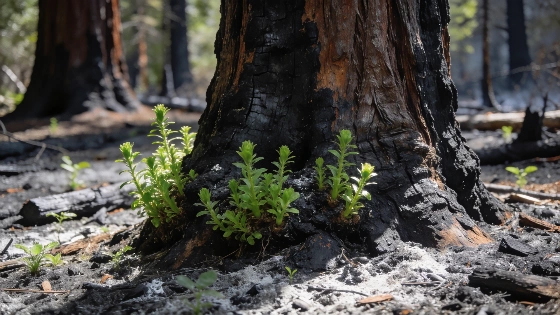
After the 2020 CZU Lightning Complex wildfire, coast redwoods in the Santa Cruz Mountains showed a strong capacity to regenerate. Two years on, researchers found that both basal resprouting and the number of new shoots rose steadily as fire severity increased, even in trees with severe injury. The CZU Lightning Complex fire started and swept through the Santa Cruz Mountains in August 2020, burning Big Basin Redwoods State Park and other protected areas. The California Parks Foundation reports that about 97% of Big Basin burned during the event, leaving behind dense regrowth and built-up fuel that still poses wildfire risks (California Parks Foundation).
The study, published in Fire Ecology by Jackson T. Carrasco, Jeffrey M. Kane, and Alan J. Tepley, examined secondary Sequoia sempervirens stands across six state and county parks. These included Año Nuevo State Park, Big Basin State Park, Butano State Park, Henry Cowell State Park, Wilder Ranch State Park, and Pescadero Creek County Park. The team selected 77 mature redwoods using a stratified random method, covering a wide range of fire damage based on the proportion of trunk height affected by charring. The article, "Prolific post-fire persistence: resilience and resprouting in the iconic coast redwood," is available as open-access research in Fire Ecology.
Fire severity and redwood regeneration
Instead of reaching a point where severe fire would stop regeneration, the likelihood of basal resprout emergence and total vegetative biomass kept rising as fire severity increased. The most telling predictor was the bole char ratio, calculated by dividing the height of trunk charring by the total tree height. Trees with higher bole char ratios produced more resprouting and shoot growth, with no sign of a threshold where regeneration dropped off.
Field crews measured tree dimensions, canopy openness, and local moisture stress. They counted basal shoots and sampled stems to estimate biomass. The study found that even trees with 100 percent bole char ratios kept strong regenerative ability, producing the most basal shoot biomass despite heavy canopy loss. Complete genet mortality was rare and limited to ridgeline sites where severe soil erosion exposed roots and lignotubers to direct flame contact.
Environmental factors and resilience
While fire severity was the main driver of resprouting, pre-fire climatic water deficit stood out as a steady secondary constraint. Redwoods in drier areas with higher cumulative water deficit produced less total resprout biomass, smaller leaf mass, and reduced leaf area. Still, even under these conditions, trees resprouted after fire. Tree size, including trunk diameter and pre-fire biomass, did not significantly affect post-fire basal resprouting within the sampled range.
The researchers also noted that trunk epicormic sprouting and basal reiteration worked as compatible strategies. Nearly half of the focal stems produced no epicormic foliage, but when epicormic sprouting did occur, it was positively linked with basal resprouting. This suggests that heat damage strong enough to trigger stem-based buds does not block internal transport or drain carbohydrate reserves.
Implications for redwood forests
The findings show that high-severity wildfire in secondary coast redwood stands does not always lead to stand loss, though canopy structure can change dramatically. The study points to the importance of both mineral soil and thick basal bark in protecting dormant bud banks during intense burns. However, the sensitivity of resprout biomass to pre-fire water deficit signals possible challenges as climate change and drought intensify across California.
Big Basin Redwoods State Park, California's oldest state park, remains a key redwood conservation area. The California Parks Foundation notes that coast redwoods are the tallest trees on Earth, able to reach over 300 feet and live more than 2,000 years, but only about 5% of the original old-growth redwood forest remains. After the CZU fire, recovery at Big Basin has shifted toward active forest management and monitoring, with the California Parks Foundation and Save the Redwoods League supporting wildfire-resilience work, including testing fuel-reduction treatments to lower future wildfire risk, promote the growth of large, mature redwoods, and increase carbon storage. The foundation states that ongoing data and monitoring will help guide forest management across the park for years ahead.
The post-fire landscape is not recovering evenly. Dense regrowth and built-up fuel at Big Basin are seen as ongoing vulnerabilities, even as redwoods regenerate. This creates a management challenge: while vegetative recovery restores canopy and biomass, it can also add to fuel accumulation if left unmanaged, highlighting the need for adaptive management strategies.
For more context on wildfire risks and community concerns in California, see this earlier breakdown.