
Wildfires in the U.S. often leave communities facing a much larger financial burden long after the flames die down. Researchers from the Conservation Economics Institute report that the most severe economic fallout can surface months or years later, as floods hit areas stripped bare by fire. FEMA notes that heightened flood risk can linger for up to five years after a wildfire, putting communities in the path of repeated hazards during rainy seasons and complicating insurance, infrastructure decisions, and public budgets.
The study, published in Trees, Forests and People, reviewed 29 wildfires across the country and cataloged 131 types of wildfire-related costs. These were sorted into nine categories, showing that most prior studies miss the full scope of wildfire damages. Researchers point to a pattern: assessments often happen soon after the fire, overlooking delayed but major consequences like flooding, erosion, ecosystem loss, and infrastructure trouble. The Conservation Economics Institute found that most studies undercount the real total damages from wildfires. Suppression spending and direct property loss only cover part of the economic hit, while ecosystem and delayed post-fire effects can drive up the final cost.
Flooding emerges as the costliest aftermath
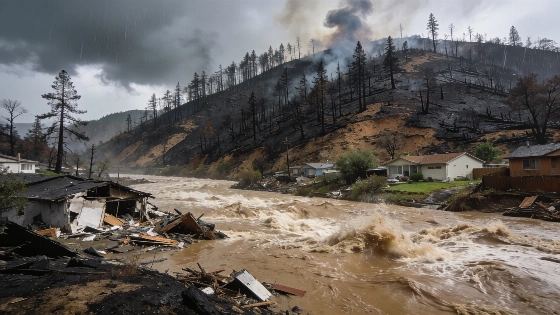
Long-term reviews of Arizona's 2010 Schultz Fire and California's 2017 Thomas Fire highlight the scale of post-fire flooding. The Thomas Fire, which burned about 281,893 acres in Ventura and Santa Barbara counties and was fully contained on January 12, 2018, saw heavy rains hit just a month after the fire started. Flash floods and debris flows killed 21 people, injured 168, destroyed 128 homes, and damaged 307 more in Montecito. The disaster caused roughly $617 million in damage, with debris piling up to 15 feet high and Highway 101 closed for days. The Thomas Fire itself destroyed at least 1,063 structures, damaged 280 others, and led to more than $2.2 billion in reported damages, including about $230 million in suppression costs. Loss of vegetation left steep slopes above Montecito exposed to intense runoff, mud, and debris, showing how wildfire-altered terrain can worsen flood risk and disaster impacts.
The analysis found that the largest share of wildfire-related costs comes from damage and destruction of structures and their contents, making up 37% of total costs. Wildfire response and containment account for 22%, while ecosystem damages-including impacts to water, carbon, timber, and species-make up 18%. These figures reflect the distribution of costs identified in the study's wildfire cases, not a fixed price ratio for every fire. The study also noted that wildfire costs have climbed steadily over the last two decades.
Climate change is expected to make these problems worse, with more frequent wildfires and heavier rainfall raising the odds and severity of post-fire flooding. The Conservation Economics Institute said climate change is likely to increase both the frequency and size of post-wildfire flooding costs, as wildfires happen more often and rainfall gets more intense. This builds on earlier breakdowns of wildfire destruction and its growing impact on communities.
Researchers stress that post-wildfire flooding can become a compounding disaster, causing the same types of community damage as the original fire. Their work calls for broader, long-term assessments to fully understand and plan for the real costs of wildfires in a changing climate. FEMA guidance notes that post-wildfire flooding and mudslides can qualify for federal Public Assistance when they create eligible disaster-related costs, including repairs to critical infrastructure, restoration of public buildings, and road repairs. Water-supply and water-quality impacts can last for years, with some burned basins showing measurable effects for up to eight years. These findings support tracking wildfire damage over several years instead of closing the books when the flames are out. For more on the economic and environmental fallout from wildfires, see the original reporting.