
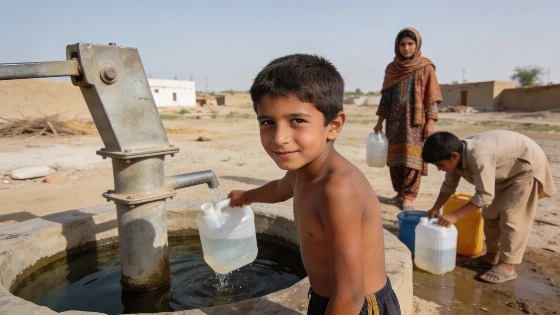
In Bhati Dilwan, a village in Sindh, Pakistan, residents have faced ongoing difficulty getting clean water as groundwater levels have dropped sharply. A former village councilor points to Nestlé, which runs a deep well in the area for its bottled water business. The councilor says children have become sick from contaminated water, and the water table has fallen from 100 to as much as 400 feet.
This account appears in the documentary film “Bottled Life” by Swiss filmmaker Urs Schnell and journalist Res Gehriger, which looks at the effects of Nestlé’s water extraction. The film includes claims that Nestlé turned down a request from the village to provide piped clean water, even as local conditions worsened.
Commercial groundwater extraction in Punjab, Pakistan, requires an approval and compliance process that typically involves documentation of water quantity and source, wastewater arrangements, a no-objection certificate from the local authority such as the Tehsil Municipal Administration or WASA, and payment of aquifer charges. Environmental approval also calls for a water balance to check if industrial facilities are taking more water than the aquifer can handle. Yet, documentation for these permits and compliance often falls short, with water-related papers frequently missing from project files, according to environmental-compliance consultancy PakERA (PakERA environmental approval checklist).
Corporate Response and Community Impact
Nestlé’s Pure Life brand, which adds minerals to groundwater before bottling, holds a major share in Pakistan’s packaged-water market. The company produces NESTLÉ PURE LIFE, NESTLÉ PURE LIFE ACTIVE, and NESTLÉ PURE LIFE Sparkling Water, confirming its ongoing role in the sector (Nestlé Pakistan company profile). John Harris, head of Nestlé Waters, called Pure Life “a jewel in our portfolio.” Nestlé has stated in written responses to the Swiss newspaper Tages Anzeiger that it built two water filtering facilities in Sheikhupura, Pakistan, serving over 10,000 people, and planned another facility in 2012. The company also reported building two schools in the same region.
Maude Barlow, a former UN chief advisor for water issues, is quoted in the film criticizing the company’s approach: “When a company like Nestlé comes along and says, Pure Life is the answer, we’re selling you your own ground water while nothing comes out of your faucets anymore or if it does it’s undrinkable – that’s more than irresponsible, that’s practically a criminal act.”
Punjab’s government has recently focused on expanding access to clean drinking water through public infrastructure. In 2024, Chief Minister Maryam Nawaz Sharif set a deadline of June 2027 for the completion of 5,734 water filtration plants across the province, with public committees and assistant commissioners assigned to monitor their operation and maintenance. The government also started a water-bottling initiative with plants in Khushab, Dera Ghazi Khan, Rahim Yar Khan, and Bahawalpur, producing a combined 10,000 19-liter bottles per day. About 4.8 million people have benefited from the Chief Minister’s Water Bottling Project, with more than 75,000 bottles delivered to households, showing the region’s reliance on decentralized bottled-water distribution (ProPakistani report).
Global Practices and Local Consequences
The documentary follows journalist Gehriger as he investigates Nestlé’s water operations in other countries. In Ethiopia, Nestlé installed a water treatment facility in a refugee camp in 2003, but left two years later, leaving the facility in disrepair and water shortages unresolved. In Lagos, Nigeria, Gehriger found that families often spend up to half their household budget on water, with only those who can afford it buying Pure Life.
Communities in Maine, United States, have also raised concerns about Nestlé’s extraction of groundwater and spring water for bottling. Residents have complained that the company profits from local water resources, while the cost to extract is minimal. Despite these concerns, local officials have welcomed Nestlé for the tax revenue it brings, and the company is supported by legal and public relations teams.
Other major companies, including Danone and Coca-Cola, also bottle groundwater for profit. The documentary suggests that Nestlé’s approach, as depicted in the film, stands in contrast to its public image as a company committed to “creating shared values.”
According to Tages Anzeiger, Nestlé declined to participate in the making of “Bottled Life,” with spokesperson Melanie Kohli stating that the company believed the project would present a one-sided and unfair view of its activities.
In 2026, Nestlé Pakistan, in partnership with the LUMS Rausing Executive Development Centre and the Syed Babar Ali Foundation, launched a multi-year executive training program on regenerative agriculture, titled “Regenerative Agriculture: Leading the Nestlé Way.” This initiative focuses on agricultural resource management and sustainability, reflecting the company’s engagement with broader environmental issues in Pakistan (The Nation).