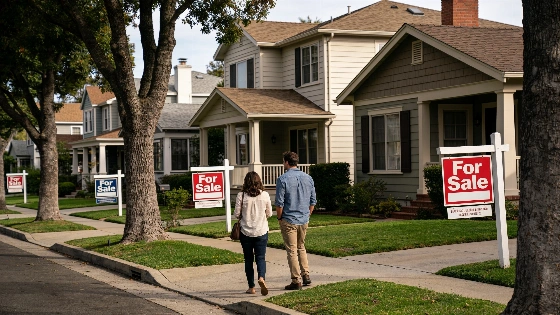
California's major metro areas are seeing more homes come onto the market after a stretch of slow sales that followed the pandemic buying rush. Economic uncertainty, high mortgage rates, and flat job growth have made buyers more cautious, while most owners remain reluctant to sell. In September 2026, existing single-family home sales in California dropped to a seasonally adjusted annualized rate of 260,410, down 3.4% from August and 6.5% from September 2025, according to the California Association of Realtors. Southern California posted the steepest regional annual drop at 9.1%, with San Diego County sales falling 12.2% year over year and 6% month over month. The statewide average existing-home price slipped from $901,420 in August to $899,720 in September, and San Diego County’s average fell 3.7% to $1.05 million.
By September 2026, the number of homes listed for sale in key California cities was still a bit below last year’s level but had climbed from the post-pandemic low seen in 2023. The highest price brackets have seen the sharpest declines, as wealthier buyers have pulled back first. Many homeowners refinanced during the pandemic, locking in lower rates and making them less likely to move, which has slowed turnover and reduced sales. Mortgage costs now weigh heavily on buyers, with the average 30-year fixed rate rising from about 6.7% to nearly 7.5% during September. Freddie Mac reported a 30-year fixed average of 7.40% in mid-October, the highest in almost three years, before easing to 7.32% for the week ending October 22. Realtor.com estimated that the jump from 6.66% in late August to 7.40% on October 8 cut buyers’ purchasing power by 7.2%. Nationally, homes for sale rose 7.7% year over year in the same period, the strongest weekly growth since late January, but affordability remains a major hurdle.
Inventory growth and price trends
Some of the new inventory comes from forced sales by highly leveraged owners who can’t hold on to their properties. These sales add to supply without creating replacement purchases, which increases available listings and puts more pressure on prices. The days of buyers scrambling to secure homes out of fear of missing out have ended. Now, many would-be buyers are waiting, hoping for better deals. The California Association of Realtors noted that "mortgage rates and affordability remain challenging, but with competition easing, well-prepared buyers may have more room to explore their options, negotiate and focus on finding the right home rather than simply hurrying to make an offer."
Nationally, pending home sales fell 7.3% in September 2026 to an index reading of 66.0, the lowest since the National Association of Realtors began tracking the series in 2001, and 11.3% below September 2025. Contract signings dropped in all four U.S. regions, with San Francisco pending sales down 3.5% year over year and San Jose down 4.6%. Lawrence Yun, chief economist at the National Association of Realtors, pointed to fast-rising mortgage rates as the main factor, as reported by Reuters. With more listings and less demand, sellers are cutting prices or offering closing-cost help, but transaction volumes remain low.
Real estate agents are now targeting cash buyers who aren’t as affected by high mortgage rates. Current forecasts suggest California home prices could bottom out around 2030, with a possible trough lasting up to 18 months. Still, affordability is a major problem. In the third quarter of 2026, typical ownership costs took up 69.9% of average wages in Los Angeles County, 69.6% in San Diego County, and 92.6% in Orange County, far above the usual 28% affordability benchmark. The national median home-sale price was $368,000, down 1% from the second quarter and 2% from a year earlier, while the quarter ended with 30-year mortgage rates near 7.3%, according to ATTOM Data Solutions.
Long-term housing outlook
California’s ongoing housing shortage and broader crisis may ease as demand drops—partly because more people are sharing homes—and as new residential construction adds to supply. The California Department of Housing and Community Development reported in October 2026 that annual residential construction had climbed 50% since 2018, along with a 6.8% drop in unsheltered homelessness. This growth is tied to multiyear state housing and homelessness programs, including voter-approved Proposition 1 funding for affordable homes (California HCD). But challenges persist, including permit delays and pushback from local communities. Legislative and enforcement efforts are underway to increase the supply of lower-priced homes, aiming to support local workers and address affordability issues.
Even with more inventory, normal affordability and transaction liquidity haven’t returned. Realtor.com reported that about 21% of listings had an initial price cut in September, the highest share in four years, while Redfin estimated that sellers outnumbered buyers by about 63% across the 50 largest U.S. metro areas. Buyer numbers were the lowest in Redfin’s data since 2013, showing that listings are piling up because buyers remain financially stretched, not because demand has bounced back to pre-pandemic levels. Nationally, housing starts dropped in September 2026, falling 5.2% month over month and 7.4% year over year, while single-family completions slipped 2.4% to an annualized 840,000 units, according to Freddie Mac and the U.S. Census Bureau.
For more on California's housing inventory trends, see previous coverage.