
Subsidized housing in Los Angeles now costs more than $600,000 per unit on average, up from about $350,000 a decade ago. Some projects even top $900,000 per unit. Public housing agencies report that total development costs swing widely based on land prices, financing, wage rules, environmental cleanup, support services, parking, accessibility, and unit count. These expenses are tracked as either hard construction costs or total development costs, which measure different things. Even as these costs climb, state and local officials keep focusing on new construction, putting many existing affordable units at risk.
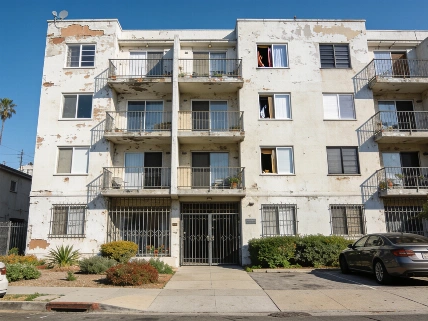
Owners of older buildings, especially those under the city's Rent Stabilization Ordinance (RSO), are under growing financial strain. The RSO covers rental units built before October 1, 1978, capping annual rent hikes and adding rules for evictions, registration, and tenant protections. The city sets the annual adjustment, which can change each year. RSO coverage doesn't permanently protect every affordable or below-market unit. Units can leave the regulated pool through exemptions, demolition, major rehab, or other legal routes. The rules for rent increases and exemptions depend on when the unit was built, who owns it, exemption status, registration, tenant details, and any affordability covenant. These regulations have made it harder for owners to keep pre-1978 buildings in shape, as reported by the Free Cities Center.
Policy impacts and economic evidence
Stanford University research found that rent control in San Francisco made tenants nearly 20% more likely to stay put. But landlords under rent control cut the rental supply by 15%, which pushed citywide rents up by 5.1%. The study looked at San Francisco's rent-control expansion and saw landlords selling or converting units, while protected tenants stayed longer. The National Multi Housing Council noted that unregulated rents in Los Angeles jumped over 46% after rent control started, much higher than the 24% rise expected without controls. These results reflect local policy settings and shouldn't be applied to other cities without considering their own rules and markets.
Some private developers and banks have shown that affordable housing can be built for less when public funding and its red tape are out of the picture. Still, comparing privately financed supportive housing to public projects requires matching accounting, since land ownership, unit size, construction type, services, financing fees, wage rules, site conditions, and affordability periods all affect costs. Delays from union rules and long approval processes-covering site purchase, environmental review, entitlements, design checks, financing, permits, utility work, and construction-slow down new units. Approval times vary by project and by whether a development gets ministerial approval under state law or needs local discretionary review.
Existing affordable housing and preservation efforts
Even as the city pours money into new construction and NGO support, homelessness in Los Angeles keeps rising. Preservation policy tackles a different issue than new builds: existing privately owned, deed-restricted, rent-regulated, or naturally affordable units can disappear through rent hikes after rules expire, condo conversions, redevelopment, neglect, or foreclosure. The risk grows when affordability restrictions have set end dates or subsidies run out, since keeping these units may need refinancing, buying, rehab, or new affordability agreements. A solid Los Angeles analysis should separate RSO units from deed-restricted ones funded by federal, state, or local programs, since each has its own legal protections and funding sources.
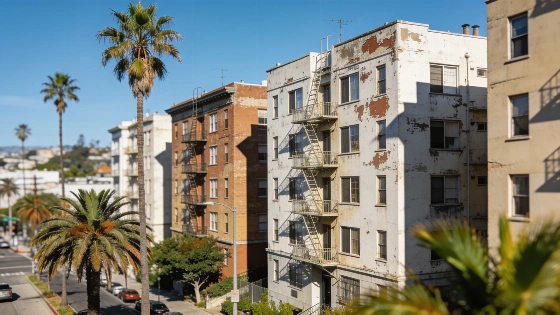
The Neighborhood Data for Social Change (NDSC) report from the USC Lusk Center for Real Estate counts about 250,000 units of Naturally Occurring Affordable Housing (NOAH) in places like Studio City, Hollywood, and the San Fernando Valley. With a 5% vacancy rate, up to 12,500 units could be open to lower-income residents-enough to house a large share of the city's 45,000 homeless people if four share each unit.
Jared Schachner, Research Assistant Professor of Real Estate Development at USC, pointed out the need to keep these units: "We just wanted to highlight that these existing units are there. Preserving them can help stave off worse homeless numbers potentially." He also mentioned the financial pressure on small landlords, who deal with missed rent, higher insurance, and legal bills, with little help to keep their buildings up.
Other cities have used private and philanthropic money to keep affordable housing in place. The Institute for Housing Studies at DePaul University tracks efforts like Amazon's housing equity fund in Seattle, Nashville, and Washington, D.C., and a community development financial institution in Portland, Oregon, which has helped keep properties like the Hotel North Bend Apartments and Weidler Commons. In Austin, the Texas Housing Conservancy Fund backs similar preservation work.
Policy alternatives and ongoing challenges
Some private banks and foundations, including the Chan-Zuckerberg Initiative, are helping landlords in South Los Angeles who have struggled with upkeep due to rent control and eviction bans. SDS Capital has put money into new affordable units. The debate over how to tackle housing affordability continues as Los Angeles deals with more homelessness and tight public budgets. Preservation tools for local governments include acquisition and rehab financing, tax-exempt bonds, low-income housing tax credits, project-based rental help, covenant extensions, code enforcement, and emergency tenant protections. How well these work depends on funding, timing, property condition, affordability rules, and whether owners and agencies are willing to make deals.
For more on the financial pressures facing California homeowners, see this earlier breakdown.