
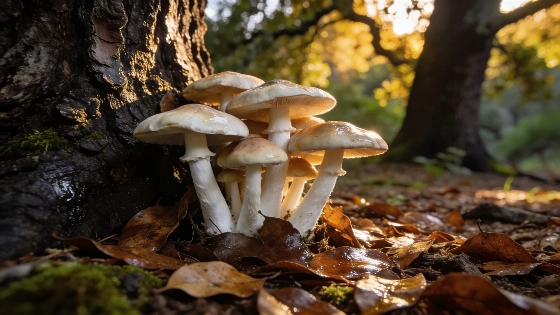
Persistent wet weather across California, driven by a strong El Niño, has led to a noticeable increase in dangerous wild mushrooms in forests and neighborhoods. The California Department of Public Health keeps administrative records and injury-data interfaces, but has not issued a formal public-health order or recent mushroom-safety bulletin about death caps, Western destroying angels, or Galerina marginata. Even experienced foragers struggle to identify these mushrooms, and poisoning symptoms may take hours to appear after eating them.
AccuWeather meteorologist Brandon Buckingham pointed out that sustained moisture, rather than El Niño itself, directly supports mushroom growth. He said, "To state that the outbreak of mushrooms is caused directly from El Niño is not entirely true, rather, it is the wetter conditions that can accompany El Niño that creates a more favorable environment for fungal growth." Buckingham advised foragers to examine mushroom features carefully and said that once poisonous mushrooms appear, little can be done except waiting for them to die off. He also warned to keep children and pets away from unidentified fungi.
The California Department of Public Health reports historical nonfatal hospitalization figures for a broad injury category in California: 1,031 in 2011, 1,132 in 2012, 1,120 in 2013, 1,145 in 2014, and 958 in 2015. These numbers are not specific to mushroom poisoning and do not show a recent increase linked to El Niño or wet weather. The Injury and Violence Prevention Branch and the California Office of Statewide Health Planning and Development compile this data from emergency-department records.
El Niño's impact on snow and water supplies
The wet pattern has raised mushroom risks but also brought hope to New Mexico's ski industry after two years of record-low snowfall. Jasen Bellomy, general manager of Pajarito Mountain Ski Area, said the strong El Niño could help tourism and water resources. NOAA research meteorologist Andy Hoell warned that rising temperatures may cause more precipitation to fall as rain instead of snow, speeding up snowmelt and evaporation. Last season, New Mexico had its warmest winter on record, and ski resorts struggled to make artificial snow because of high temperatures. Resort visitation dropped 17 percent compared to the 2023-24 season, according to Ski New Mexico.
Climate scientist Jeremy Klavans of the University of Miami said predicting snowfall is difficult as global warming interacts with El Niño. Since 1970, New Mexico's average annual temperature has risen by 3.7 degrees Fahrenheit, making it harder to forecast whether winter precipitation will come as snow or rain. Klavans said even a strong El Niño is likely to be a brief interruption in the region's long-term trend of declining precipitation.
Broader weather shifts and ongoing risks
El Niño is affecting storm activity across the United States, with the West Coast and southern states seeing wetter conditions. AccuWeather senior meteorologist Tom Kines described the pattern's effect on current weather systems, saying stormy conditions match El Niño's influence. The National Weather Service has issued winter weather advisories for parts of the Midwest, Great Lakes, Northeast, Pacific Northwest, and Alaska, with some areas expecting significant snowfall. Meteorologists caution that individual storms cannot be directly linked to El Niño, since local temperatures and storm tracks ultimately decide whether precipitation falls as rain, snow, or ice.
NOAA's 2026-27 Winter Outlook predicts wetter-than-average conditions for the Southwest, Southeast, and East Coast, while much of the northern United States is expected to see warmer-than-average temperatures. The mix of unusually warm Pacific waters and rising global temperatures is producing varied effects: stronger winter precipitation in some regions, but less reliable snowfall and continued drought pressure in the Southwest.
California's experience with climate-driven risks goes beyond weather patterns. As reported earlier, rising insurance costs and climate disasters are changing the financial landscape for homeowners and communities across the state.