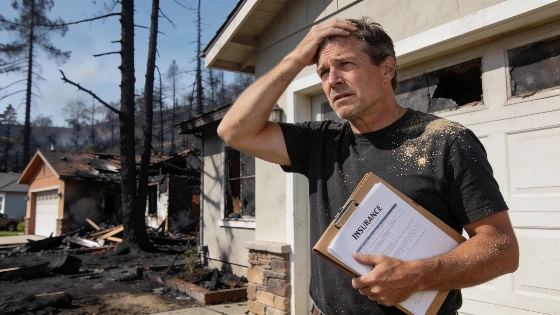
After the Palisades and Eaton fires in January 2025, thousands of California homeowners found themselves facing growing uncertainty about their insurance. Many struggled to secure affordable policies or even basic coverage. The market came under more pressure as major insurers, including State Farm, announced plans to drop large numbers of policies, citing wildfire risk. By June 2026, the state’s FAIR Plan, intended as a last-resort insurer, had nearly 700,000 policies in force as private companies pulled back. The FAIR Plan offers narrower protection than standard homeowners policies and often requires extra coverage for excluded risks. Its growth highlights the shrinking private market. Insurance experts point out that FAIR Plan policies usually cost more than traditional insurance and are not meant to replace comprehensive private coverage. The plan’s expansion shows a split: lower-risk properties tend to keep private coverage, while higher-risk homeowners end up with the FAIR Plan.
California’s insurance market ranks among the world’s largest, handling about $452 billion in annual premium volume. The crisis has created a clear divide between private-market repair and public catastrophe coverage. State Senator Ben Allen of El Segundo pushes for faster rate reviews and broader use of risk and mitigation data. He also calls for statewide investments in wildfire defenses and tougher enforcement against insurers that delay or deny legitimate claims. Allen has said that recent reforms allowing forward-looking risk projections fall short, arguing they "don’t actually get to the core of the problem, which is making these communities less risky." Former San Francisco Supervisor Jane Kim, on the other hand, proposes a state-run, nonprofit disaster insurer—her "Natural Disaster Insurance for All" plan. This would create a public pool to cover catastrophic losses like wildfire and flood, while private insurers would handle other risks. Kim argues that private insurers may eventually leave wildfire coverage as they did with earthquake coverage, so a public system is needed. She estimates Californians spend about $18 billion on home insurance each year, with $3 billion to $6 billion tied to wildfire coverage. Her plan would shift the catastrophe portion of premiums into a state fund to support reinsurance, claims payments, and investments in wildfire prevention and community hardening.
Limits and powers of the insurance commissioner
The insurance commissioner, elected statewide, oversees the Department of Insurance. This office licenses and regulates companies, reviews rates, investigates complaints, and enforces state insurance laws. Proposition 103, passed by voters in 1988, requires the department to review proposed rate changes for major lines like homeowners and auto insurance. It also lets consumers and advocacy groups challenge proposed increases through an intervenor process. Still, the commissioner cannot create new insurance programs alone; such changes need legislative approval. Stanford insurance policy expert Michael Wara explained, "The power that the commissioner actually has is to administer the system and enforce the laws on the books." The regulatory structure gives the commissioner authority over rate filings, market conduct, consumer protection, and insurer compliance. But major changes, such as setting up a public disaster pool or restructuring catastrophe coverage, would need the Legislature’s cooperation.
Even with these limits, the commissioner can shape the market through programs like Safer from Wildfires, which ties mitigation efforts to insurance discounts. Both Allen and Kim want closer oversight and more transparency for the FAIR Plan, including reforms to its governance and public accountability. Kim’s public Disaster Insurance for All proposal would need legislative support and could change how disaster coverage works in California. She describes the disaster-insurance idea as a proposal, not a finished system, and says big questions remain about financing, governance, reinsurance, eligibility, and how responsibilities would be split with private insurers. Allen, meanwhile, suggests an "office of new business" to attract more insurers to California and wants the FAIR Plan to return to "a true safety net and not the default option." Both candidates back stronger post-disaster claims oversight, responding to consumer complaints about delays, denials, and poor communication after major fires. Kim’s proposals include penalties for delayed claims, rate freezes after a policyholder files a claim, immediate payments, market-conduct exams, and a public dashboard showing insurer performance. Allen’s plan also calls for tougher enforcement, clearer explanations of claim denials, higher upfront payments in some cases, and real-time reporting of delayed or outstanding claims after disasters. Both campaigns support more public scrutiny of FAIR Plan operations and how insurers treat policyholders.
Auto insurance and affordability
Auto insurance rates have jumped sharply, becoming a major issue. Companies covering about 85% of California’s auto insurance market raised rates by more than a third from 2023 to 2025, according to the Los Angeles Times. The state already runs a low-cost auto insurance program for eligible drivers, now covering around 67,000 policies. Allen wants to raise awareness of this program among qualifying drivers. Kim supports expanding eligibility and eventually creating a public auto insurance option. Her campaign links broader low-cost auto access with public reporting on claim denials, payment times, and insurer performance. The push to expand low-cost auto insurance puts affordability at the center of the debate over the commissioner’s authority to approve rates, enforce consumer-protection rules, and decide if current programs reach enough motorists. California’s rate-regulation system lets the Department of Insurance review proposed auto-insurance rate changes under Proposition 103. But expanding eligibility or the program itself would require policy and possibly legislative action.
Insurance, housing, and wildfire risk
The insurance crisis connects directly to California’s housing shortage and wildfire risk. Allen has called for limiting new development in high-risk wildfire areas and wants state and local officials, builders, firefighters, and insurers to work together to cut community-level risks. His platform focuses on rebuilding the private market, not replacing it with a state insurer. He proposes faster rate reviews, better use of catastrophe and mitigation data, tougher oversight of claims handling, public investment in home hardening and community-scale wildfire defenses, and a new look at development in the highest-risk areas. This approach assumes insurers will stay or return if rates reflect forward-looking risk and if mitigation lowers expected losses enough to support affordable coverage. Economist Judd Boomhower of UC San Diego noted that the Department of Insurance does not control local zoning or development decisions. Kim argues that limiting new construction in high-risk zones will not remove the threat to existing communities, especially as wildfire danger changes over time. Boomhower pointed out the difference between building new communities in fire-prone areas and relocating current residents, saying a home’s vulnerability depends on both individual and neighborhood factors.
Voters will decide between these approaches in the November 3 general election. The next commissioner will need to work with lawmakers and local officials to carry out any major changes to California’s insurance system. The debate matters for wildfire coverage and for the broader $452 billion insurance market in California, as reported by Heatmap and Insurance Business America. The result will set the direction for restoring private capacity through regulation and risk reduction, or moving toward public catastrophe coverage as a social-insurance function.
For more on the candidates and the changing insurance landscape, see our previous coverage.