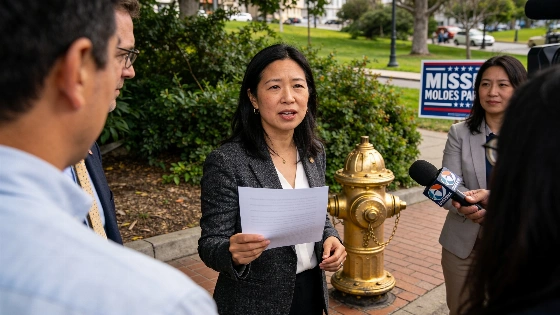
Jane Kim holds a reported 52.6 percent of the vote and leads by about 400,000 ballots in the still-uncalled race for California insurance commissioner. The progressive former San Francisco Supervisor spoke to supporters outside the golden fire hydrant near Mission Dolores Park, calling her lead a "clear mandate" even as the official result remains unsettled. According to The Sacramento Bee, Kim led Ben Allen with roughly 52% to 48% shortly after 8 a.m. on November 4, 2026. Insurance Journal put Kim's lead at more than 265,000 votes at that point, while KQED's November 5 update listed Kim at 52.5% (3,945,955 votes) and Allen at 47.4% (3,560,435 votes), with about 60.16% of votes counted. These numbers show a sizable but uncertified advantage as ballots continued to be processed across California.
Kim's opponent, state Sen. Ben Allen of Santa Monica, has not conceded. The California Secretary of State's office reported that only about 64 percent of the expected vote had been counted as of Friday morning, leaving Allen with a narrowing but not closed path to victory. Allen's campaign spokesperson did not immediately respond to requests for comment. Insurance Journal noted Kim raised more than $700,000 during the campaign, highlighting the contest's high profile and stakes.
Democratic Showdown and Voter Turnout
This year's race featured two Democrats on the ballot, an unusual situation that left Republican voters without a candidate. The 2026 general-election matchup resulted from California's top-two primary system, which advanced Kim and Allen from the June 2 primary as the leading candidates. CBS Sacramento identified Kim as a former San Francisco supervisor and Allen as a Southern California state senator, both running as Democrats. The winner will succeed Ricardo Lara, the Democratic insurance commissioner first elected in 2018, who is term-limited. The lack of a Republican candidate appears to have affected turnout: the Secretary of State's office reported about 1.2 million fewer votes cast for insurance commissioner than for governor, a much larger gap than in previous cycles when both major parties had candidates.
Policy Visions and Campaign Proposals
Kim and Allen presented sharply different approaches to California's insurance market. Both pledged to challenge the insurance industry, but Kim's campaign targeted "corporate greed" and considered all options, including replacing parts of the private insurance sector. Her main proposal, "Natural Disaster Insurance for All," would create a public, nonprofit state program funded by premiums, with some funds going to wildfire prevention and home-hardening. The plan would not necessarily remove private insurers from the market; private carriers could still administer policies and handle routine claims while the public program took on disaster risk. Kim acknowledged that starting such a program would be complex and could take years, as reported by CBS Sacramento and CalMatters.
Allen, in contrast, focused on stabilizing and maintaining a functioning private market rather than replacing private disaster coverage with a new state-run system. He aimed to protect policyholders and keep insurers operating in California. Allen's proposals included speeding up the review of insurer rate-change requests and requiring more explanation when claims were delayed or denied after disasters. He also pushed to move homeowners off the FAIR Plan (California's insurer of last resort) and back onto traditional property-insurance policies. He campaigned on restoring competition and improving post-disaster fairness, as well as strengthening resilience and continuing efforts to modernize rate review, according to Insurance Journal and FOX40.
Political Background and Endorsements
Kim served on the San Francisco Board of Supervisors from 2011 to 2019, representing District 6. She later worked as a regional director for U.S. Sen. Bernie Sanders' 2020 presidential campaign and as California director for the Working Families Party. Her campaign for insurance commissioner received endorsements from Sanders, U.S. Rep. Ro Khanna, and Rep. Pramila Jayapal. Kim has described the commissioner's office as "a powerful office that has been underused."
The policy dispute between Kim and Allen centered on California's growing struggle to maintain affordable and available property coverage, especially in wildfire-prone areas. Allen pointed to availability constraints and affordability pressures as insurers raised premiums, citing increased disaster risk and higher replacement costs. Kim also supported blocking insurers from raising rates or dropping coverage after a policyholder files a claim. The two platforms offered distinct responses to the same market pressure: public assumption of catastrophic risk under Kim's proposal versus faster regulation, mitigation, and private-market repair under Allen's approach, as reported by LAist and The Sacramento Bee.
The California insurance commissioner is the state's principal elected insurance regulator and oversees the Department of Insurance. The official voter guide states the commissioner enforces state insurance laws, licenses and regulates insurance companies, and responds to public questions and complaints. The 2026 election shaped not only an elected office but also the direction of state oversight during an insurance-availability crisis. As of November 5-6, 2026, Kim held a significant lead in reported returns, but the contest had not yet been formally certified by the Secretary of State, and the final outcome remained pending as ballots continued to be counted.
For more on the race and its implications, see previous coverage.