
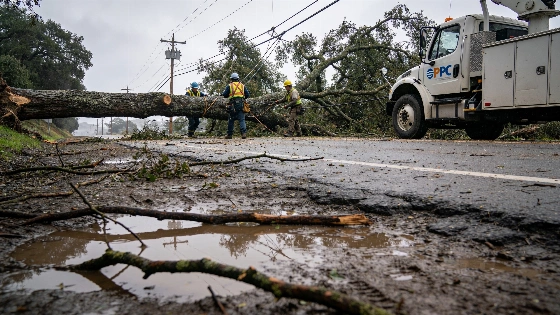
As El Niño-driven storms approach California this winter, Pacific Gas and Electric Co. (PG&E) says some rural communities could lose power for up to 48 hours. The utility points to high winds and soaked ground as key reasons trees and power lines may fall, especially in places like Marin County and northern Napa County, where earlier storms have already caused major disruptions. Saturated soil, falling trees, and damaged distribution lines all raise the risk of outages in these rural areas.
Mark Van Gorder, a PG&E government relations representative, told the American Canyon City Council that outages in rural regions could last from 24 to 48 hours. He urged residents with family or friends in those areas to start preparing now. American Canyon, which has a PG&E regional service center, is seen as less likely to face long outages.
Storm Impacts and Utility Response
PG&E's emergency preparedness team works with meteorologists to predict storm impacts up to ten days ahead. Angie Gibson, vice president of emergency preparedness and response, said that within 96 hours of a forecasted storm, the utility estimates outage numbers, decides how many repair crews are needed, and starts notifying customers. PG&E can send crews to high-risk areas in advance and, if needed, call on mutual aid from other utilities in the U.S. and Canada. The utility uses smart meters for automatic alerts when power is lost, but customer reports still help identify the exact causes of outages, such as tree damage to lines.
Gibson explained that PG&E gets automatic alerts when smart meters lose power, but customer reports can help pinpoint the cause, like a tree falling on a line. For customers who depend on medical equipment, the utility offers hotel vouchers during outages and encourages those individuals to consider evacuating before major storms if possible. The availability of hotel vouchers and other help may depend on the outage cause, customer eligibility, and local emergency conditions.
Community Preparedness and Recent Outages
Recent winters have brought major outages in the Bay Area and beyond. In early 2024, atmospheric river storms left 235,000 PG&E customers without electricity in a single day. Last Christmas, 150,000 customers lost power for several hours due to strong winds and rain. Landslides have blocked highways in Sonoma, Marin, and the Santa Cruz Mountains, sometimes trapping residents and making evacuation tough. PG&E outage statistics can refer to customers interrupted, customer-hours without service, or maximum concurrent outages, and these distinctions matter for understanding the scale and duration of service interruptions.
Cal Fire's Santa Clara unit chief, Marcus Hernandez, said that cumulative rainfall can weaken soil, making trees more likely to fall and damage power lines even in moderate winds. He urged property owners to clear gutters, drains, and dead tree limbs to lower risks. John Ruiz, the Red Cross's regional disaster officer for Northern California Coastal Region, said most evacuees stay with friends or family, but the Red Cross operated 83 shelters in 2023 and 2024, providing 9,000 overnight stays for storm evacuees.
Residents are encouraged to build up emergency supplies gradually, such as setting aside extra canned food or saving travel-sized toiletries. Small toys can help keep children busy during long outages. For more on how California's leaders have addressed cost-of-living challenges, see this reported earlier.
Risks and Ongoing Challenges
Highways like the coastal stretch of Highway 101 in Del Norte County remain at risk for landslides and flooding, which can cut off communities. Emergency responders can provide mutual aid during local storms, but widespread severe weather can stretch resources across the state. Ruiz said that in 2023 and 2024, the scale of response needs made it hard for one region's Red Cross team to support another, showing why local preparedness is so important.
PG&E continues to urge customers to update their contact information for timely alerts and to take steps before storms arrive. The utility's approach combines advanced forecasting, pre-staged crews, and community outreach to help reduce the impact of outages during this El Niño winter. For more on utility preparedness and public safety, readers can check the California Public Utilities Commission's wildfire safety resources.