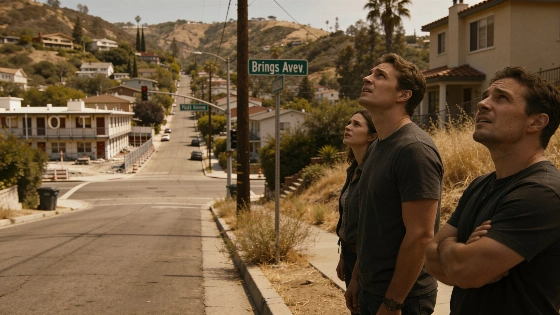
Plans to replace an 80-year-old motel at the corner of Briggs Avenue and Foothill Boulevard with a five-story affordable housing complex have triggered urgent debate in La Crescenta, where wildfire evacuation remains a pressing issue for the hillside community. The proposed project would add 66 new apartment units at a major junction that serves as a main route for hillside homes, according to the Los Angeles County Department of Regional Planning. The development could house hundreds of residents, directly below existing homes that already rely on Briggs Avenue during emergencies.
The proposed development would bring 66 new apartment units to an area officially designated as a Very High Fire Hazard Severity Zone by the California Office of the State Fire Marshal. The state's Fire Hazard Severity Zone system classifies wildfire hazard based on fire history and factors like vegetation, terrain, and weather patterns. The mapping aims to show the likelihood and expected behavior of wildfire over decades. Residents and city leaders argue that adding hundreds of new residents at this intersection could create a dangerous bottleneck during a wildfire evacuation, since Briggs Avenue and Foothill Boulevard provide the main route out of the neighborhood for many hillside homes. The absence of a completed traffic study or evacuation modeling has been noted by community members who want further analysis of evacuation capacity, roadway width, and vehicle demand.
Evacuation challenges and community response
Briggs Avenue already serves as the primary evacuation route for hundreds of homes located above the proposed site. Tatyana Esmaelian, a local resident, described the risk of gridlock if a wildfire forced a mass evacuation, referencing past disasters: "I see this as a disaster happening, where it's a repeat of Palisades Fire meets Eaton Fire, where people will get gridlocked to come out." The evacuation objection is grounded in the area's hillside geography and the reported role of Briggs Avenue as a critical route for emergency egress.
Chris Kilpatrick of the Crescenta Valley Town Council called the location "probably the worst place in the community to put a development like this." Kilpatrick noted that previous evacuation drills have shown it can take hours for residents to leave the area, and warned that concentrating more people at the intersection could intensify the problem. "In past evacuation drills, the community has expressed that it took hours for the community to evacuate, and the most dense development in the community, potentially situated at the chokepoint, where Briggs meets Foothill Boulevard, could create a problem," Kilpatrick said. The available records do not specify the dates or methodology of these drills, but the council's position reflects ongoing community concern about evacuation times and congestion.
Concerns about evacuation safety in high-risk fire zones have become more prominent across California, as highlighted in an earlier breakdown of wildfire evacuation orders affecting vulnerable communities. The California Office of the State Fire Marshal provides an interactive viewer for parcel-level hazard designations, which is used by local governments and residents to assess wildfire risk Fire Hazard Severity Zones.
Legal limits and calls for further study
The proposed apartment complex falls within the district represented by Los Angeles County Supervisor Kathryn Barger. While Barger was unavailable for an interview, her office stated that California's affordable housing laws prevent local governments from blocking such projects, even in areas with significant fire risk. The controversy reflects a broader conflict between California's affordable-housing requirements and local governments' ability to reject projects on land-use or public-safety grounds. "Because of California's affordable housing crisis, state law prevents local governments from blocking projects like this one," her office stated, as reported by ABC7. County officials were expected to consider public funding for the project within the following months, while residents sought additional evacuation analysis before approval.
Esmaelian argued that the county should evaluate the project based on the neighborhood's specific hazards: "It's not something that could be blanketed to every community, and because we're in a very, severely high fire zone, it's not appropriate." She is urging the county to conduct a comprehensive evacuation study before moving forward. The Los Angeles County Sheriff's Department reported that it is working with fire and public works officials to review the situation. The department indicated that interagency consideration is underway, but no completed evacuation study or formal safety determination has been released. The review may involve emergency access, traffic operations, evacuation routing, and fire-code compliance.
Residents emphasized that their opposition is not to affordable housing itself, but to the risks posed by placing a dense development at a critical evacuation point. "We're both in favor of reasonable development, as well as in favor of safety," Kilpatrick said. "We are opposed to putting something in a place that is irresponsible, that puts existing residents' lives at risk because of where we live along the foothills," she said. The immediate requested action from residents is an evacuation study or comparable public-safety review before county officials advance the development or allocate public funding. The project remains under review, with public-safety and funding questions unresolved, according to the Los Angeles County Board of Supervisors and public-safety agencies. Further details on the project's status and any upcoming votes can be found in county agenda and project records and in ABC7 reporting.