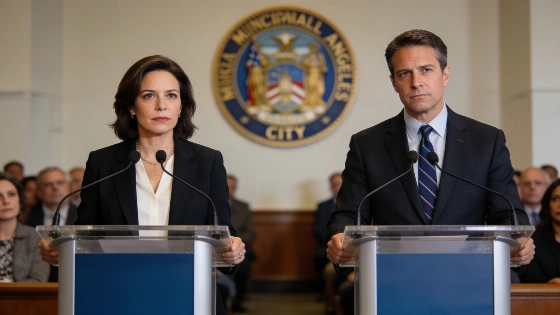
Hydee Feldstein Soto's loss in the primary upended the Los Angeles city attorney race. Her defeat marked the first time in nearly a century that an incumbent city attorney failed to advance, highlighting voter frustration with current legal leadership. In the June 2026 primary, Marissa Roy led with about 43% of the vote, John McKinney followed with nearly 29%, Feldstein Soto took about 18%, and former Deputy City Attorney Aida Ashouri received roughly 10%. Since no candidate won a majority, Roy and McKinney moved on to the November runoff. The office, which advises the mayor and City Council, manages municipal contracts, defends Los Angeles in civil litigation, and prosecutes misdemeanor cases, now sits at the center of a contest between Roy and McKinney-two candidates with sharply different visions for the job. The Los Angeles Times described the race as a choice between a deputy attorney general running as the "people's lawyer" and a county prosecutor focused on public safety and quality-of-life offenses.
Roy, a deputy state attorney general, has centered her campaign on tenant protections and labor rights, targeting landlords and employers accused of harming vulnerable residents. Her work on the state housing justice team and backing from progressive figures like Senator Bernie Sanders have helped her rally renters and workers frustrated by high costs and weak enforcement. Roy's priorities include tenant protections and wage-law enforcement, along with action against those violating labor rules. She has proposed bringing more civil litigation in-house to cut the millions Los Angeles spends on outside counsel, and argued that a stronger city claims process could resolve legitimate cases efficiently while focusing resources on defending against frivolous claims. Her campaign presents the city attorney as an active consumer, housing, and labor enforcer rather than mainly a misdemeanor prosecutor.
McKinney, a longtime deputy district attorney with nearly 30 years of experience, has made public safety and the daily realities of municipal law enforcement his focus. Supported by law enforcement unions and traditional prosecutors, he says the city attorney should put neighborhood safety first, support police, and address quality-of-life offenses that affect businesses and residents. McKinney has named organized retail theft and drug dealing as priorities, and said he would work with Los Angeles County District Attorney Nathan Hochman to reduce crime. He also points to his trial experience to decide quickly which lawsuits against the city should be defended or settled, aiming to control legal costs. His approach puts courtroom prosecution and operational law enforcement at the center of the office's effectiveness.
Primary upset reveals voter dissatisfaction
Feldstein Soto's unexpected elimination in the June primary signaled broad dissatisfaction with the city's legal direction. Critics pointed to slow enforcement of tenant protections and ongoing friction with the City Council as key weaknesses of the outgoing administration. The primary exposed a wider debate over the city's legal priorities, turning what could have been a routine reelection campaign into a referendum on the city attorney's practical authority. Roy responded to this discontent by targeting corporate landlords, wage theft, and tenant harassment, while McKinney highlighted his homicide-trial and prosecutorial background as proof of readiness to lead. The November runoff became a direct choice between two sharply different legal agendas, with Roy stressing progressive civil enforcement and McKinney focusing on public-safety prosecution. For more on how city legal decisions connect with housing policy, see this earlier breakdown.
Contrasting agendas for city attorney
Roy's platform calls for aggressive legal action against employers and landlords who break city laws, as well as litigation to protect immigrant communities from federal overreach. She has described her vision for the office as the "people's lawyer" for Los Angeles. McKinney, in contrast, frames his campaign as a return to basics-emphasizing the city attorney's duty to maintain order and support law enforcement. Supporters of each candidate see the office as a tool for either transformative legal advocacy or renewed focus on public safety and stability. The city attorney's legal mandate creates the structure for this policy divide: the office acts as legal adviser to the mayor, City Council, departments, boards, and city workers, while also overseeing contracts, defending the city in civil suits, and prosecuting misdemeanor cases. McKinney's focus on neighborhood enforcement addresses municipal misdemeanors and city-level quality-of-life issues, while Roy's proposals rely on civil litigation and administrative enforcement. The winner will have to allocate one citywide legal apparatus across litigation, advice, contracts, and prosecution.
Impact of the city attorney's office
The city attorney's office shapes Los Angeles' legal framework, from drafting ordinances to defending the city in civil lawsuits and prosecuting misdemeanors. The next officeholder will oversee more than 1,000 attorneys and administrative employees and a budget of about $200 million, inheriting broad discretion over which offenses to pursue, how to enforce worker protections, and how to allocate legal resources across neighborhoods. The direction chosen in this election will influence legal priorities and enforcement strategies throughout Los Angeles for years. According to preliminary results reported by MyNewsLA, early November 2026 figures showed Roy leading McKinney by a wide margin, with Roy receiving 355,866 votes (66.16%) and McKinney 182,055 votes (33.84%). These results, based mainly on vote-by-mail ballots received before Election Day, put Roy on track to become Los Angeles' next city attorney and possibly the second woman to hold the citywide office, with the final tally expected later in November. The outcome will set how the office balances enforcement priorities with its broader civil-defense and advisory workload, shaping the city's legal landscape for the foreseeable future.