
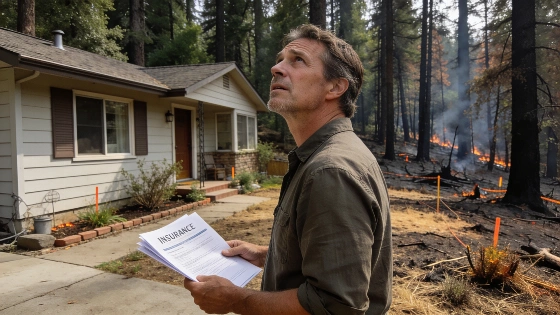
In the forested foothills of Northern California, many homeowners now face a tough reality: insurance coverage is harder to secure and costs more to keep. Over the past decade, a series of devastating fires has changed how insurers assess risk, leaving entire communities struggling to find affordable protection for their homes. The California Department of Insurance reported a 169.6% loss ratio for homeowners insurers in 2025, while the national average stood at 55.1%. A loss ratio above 100% means claims losses outpaced premium revenue, which has pushed insurers to raise rates or pull back from high-risk areas. The state's new "Zone 0" defensible-space rules now apply to State Responsibility Areas and Very High Fire Hazard Severity Zones, affecting about 3.7 million residents across 3,626 square miles.
Some residents in the highest-risk zones have seen premiums surge, while others have lost coverage. The private insurance market, once a steady option, has pulled back from regions where megafire risk is now seen as too high to underwrite. This shift has left families searching for alternatives and local officials working to restore access to basic insurance. The California FAIR Plan, the state's insurer of last resort, has seen policy counts climb in foothill and wildfire-exposed areas. As of September 30, 2026, El Dorado County had 28,134 FAIR Plan policies and Placer County had 19,053, while Sacramento County had 1,860. Ventura County saw a sharp increase, with policies rising from 3,316 in 2022 to 16,926 in 2026, a 410% jump. These numbers show how stress on the insurance market varies by county.
Communities Respond to Market Retreat
Wildfire-prone areas are working to bring insurers back, but the scale of recent destruction makes the task difficult. California's insurance-market overhaul began after Governor Gavin Newsom issued an executive order in September 2023, calling for action on the worsening homeowners-insurance market. The resulting Sustainable Insurance Strategy brought faster rate reviews, allowed forward-looking catastrophe models, and let certain reinsurance costs factor into rates. In return, insurers using these tools must write more policies in high-risk communities, creating a regulatory tradeoff between actuarial flexibility and market access. The California Department of Insurance reported a 27% drop in average monthly new FAIR Plan policies from 2025 levels, hinting at some easing in demand, though the FAIR Plan remains a key fallback for households unable to get private coverage. The department also set an 85% writing benchmark for larger insurers in wildfire-distressed areas, aiming to expand coverage in places like Napa County and ZIP codes flagged as undermarketed.
On November 10, 2026, Insurance Commissioner Ricardo Lara announced an expanded commercial-property insurance moratorium covering more than 50,000 Californians, under the Business Insurance Protection Act (SB 547), which took effect January 1, 2026. The state's residential-moratorium framework protected over 1.2 million homeowners during 2025 and more than 4 million since it began in 2019. The moratorium is a temporary measure while insurers reassess wildfire exposure and market capacity. The Department of Insurance reported that 12 insurance groups, including Farmers and Mercury, have announced plans to stay in or expand within wildfire-affected areas. The list also includes Auto Club of Southern California, CSAA, USAA, Liberty Mutual, Travelers, Pacific Specialty, PURE, California Casualty, MS Transverse, and TRUE. The department's next steps involve finalizing regulations to add the Safer from Wildfires program into insurance pricing and improving transparency around property-level wildfire-risk scores. More details are available in the California Department of Insurance announcement.
For a broader look at how natural disasters are changing insurance, see this recent report on rising home insurance costs across the United States.
Industry and Consumer Uncertainty
As megafires keep threatening communities, the insurance industry faces growing pressure to adapt. Homeowners are left weighing their options, with some turning to state-backed programs or risk retention strategies. The FAIR Plan has introduced up to two wildfire-related discounts on dwelling policies effective November 15, 2025 or later, recognizing mitigation measures such as Class A roofs and enclosed eaves. Other qualifying steps include ember- and fire-resistant vents, multipane windows or shutters, and community-level actions like joining Firewise USA sites. Still, meeting mitigation standards, including the new Zone 0 defensible-space rules, does not guarantee private insurance will return, as broader catastrophe and accumulation concerns remain for insurers. The future of insurability in high-risk regions is unresolved, with the main question still open: can private insurance continue in a landscape shaped by increasingly severe wildfires?