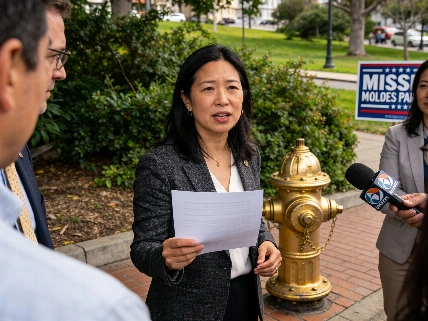

Scott Wiener, known for pushing pro-housing laws in California, has clinched the race to take over Rep. Nancy Pelosi's seat in Congress. He beat San Francisco Supervisor Connie Chan in California's 11th Congressional District, pulling in 153,339 votes, or 53.8 percent, compared to Chan's 131,492 votes, or 46.1 percent, according to KQED's certified results. The race was called at 8:25 a.m. Pacific time on November 6, 2026. The New York Times earlier reported 142,519 votes (54.0 percent) for Wiener and 121,206 votes (46.0 percent) for Chan, based on 263,725 votes tallied. This was the first open contest for the seat since 1987, after Pelosi's long run representing the district. Pelosi backed Chan, giving her a major institutional lift, but Wiener kept a steady lead throughout the campaign. The outcome showed a handoff between two high-profile San Francisco Democrats and highlighted the split between city political groups. The New York Times summed up the result: "Scott Wiener, a Democrat, wins the 11th District in California."
Wiener has shaped much of California's housing agenda, writing bills like Senate Bill 79, which lets developers build denser housing near transit by bypassing local zoning, and SB 607, which cuts down CEQA review time to move development applications faster. His move to Congress is seen as a win for those pushing to boost housing supply in the state. Wiener has also said he plans to take on artificial intelligence risks, posting on X on November 4 that he aims to "rein in the threat of artificial intelligence."
Wiener advanced to the general election after leading a June primary with 95,816 votes (40.7 percent) out of 12 candidates, while Chan came in second with 69,899 votes (29.7 percent), setting up their direct contest. Chan conceded on November 4, 2026, after reviewing the remaining ballots and seeing no way to catch up, as reported by ABC7 News. Her campaign noted the margin might shrink but saw no path to win. The concession wrapped up a closely watched Democratic primary-style race rather than a typical Republican-versus-Democrat matchup.
Local ballot measures face defeat
In San Mateo County, Menlo Park's Measure P, which would have forced citizen elections for new development on city-owned downtown parking lots, looks set to fail. Early numbers from the Palo Alto Daily Post showed 3,799 "no" votes (52.2 percent) to 3,474 "yes" votes (47.8 percent), with ballots still being counted. The measure would have blocked the city from moving ahead with public-housing projects on those parking lots. Local businesses said the lots were needed for downtown shoppers, framing the debate as both a parking and commercial access issue as well as a housing question.
Santa Clara County saw a similar result for Los Altos' Measure D, which also targeted parking lot projects. Early returns showed 4,517 votes against (58.8 percent) and 3,160 in favor (41.2 percent). Unlike Menlo Park's proposal, the Los Altos measure aimed to stop a city-backed performing-arts center on downtown parking-lot land. Both measures would have limited city councils' ability to move projects forward on municipal land without a separate public vote. Their likely defeats point to voter pushback against shifting redevelopment decisions from elected city officials to required citizen elections, though these are still early results. This trend follows recent statewide moves, including approval of major housing bonds and the defeat of rent control in Redwood City, as reported earlier.
Coworking and new residential sales
The Bay Area saw coworking space expand sharply in the third quarter, adding nearly 250,000 square feet-the biggest jump among major U.S. markets, according to a Hubble market report. The region's coworking inventory now totals 7.5 million square feet. In San Francisco, the Mission District made up over 20 percent of the city's new coworking space, while the Financial District saw no new additions. Palo Alto and downtown Oakland also stood out as coworking hubs.
Traditional office rents in San Francisco have leveled off at $64.92 per square foot, down slightly from the previous quarter, while Bay Area-wide rents climbed to $56.99 per square foot. The Peninsula remains the priciest, with Menlo Park, Daly City, and Palo Alto all topping $100 per square foot.
Several new residential properties changed hands this week in wealthy Bay Area neighborhoods. In Atherton, a new home at 97 Santiago Avenue sold for $26.2 million, or $2,475 per square foot. Benchmark Builders developed the property, which last sold for $9.3 million in 2022 and was listed by Compass' Zach Trailer, with Coldwell Banker Realty's Jimmy Gu representing the buyer. In Sonoma, 1523 Sperring Road sold for $10.4 million, or $1,825 per square foot, after being designed and built by Landers Curry with Christine Curry Design. W Real Estate's Emma Curry and Compass' Matt Sevenau listed the property, and Compass' Maurice Tegelaar represented the buyer.