

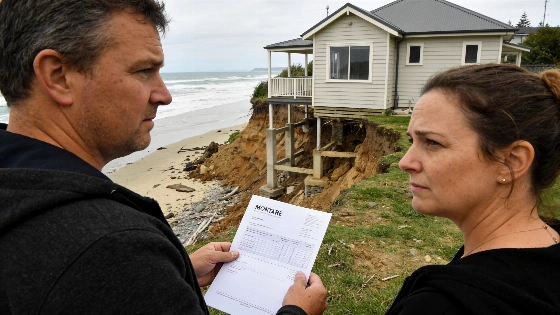
Homebuyers in New Zealand looking to finance beachfront properties now encounter tighter lending rules if the property faces erosion or other natural hazards. Westpac stands as the first major bank in the country to publicly use property-specific risk assessments in its mortgage process, according to RNZ. The policy, active since November 11, 2026, requires new residential mortgage applications to undergo checks for risks like flooding, landslides, and coastal erosion. Applicants receive a Westpac Natural Hazard Risk Insights report, which draws from the same data the bank uses in its lending review. Existing mortgages remain unchanged by this policy, and Westpac has said it does not plan to reject applications solely because of natural-hazard exposure.
Instead of approving the full requested amount, buyers might get a loan up to $200,000 less if the property is flagged as risky. For instance, someone seeking a $1 million mortgage on a beachfront home could be approved for only $800,000. The bank may also shorten the mortgage term, offering a 20- or 25-year loan instead of the usual 30 years for homes with higher risk. Jo McGregor, Westpac's head of consumer lending, told RNZ these outcomes should affect the loan amount or term in no more than 2% of cases, and only in specific situations rather than as a broad rule for all coastal or flood-prone properties.
How Westpac's risk assessment works
Jo McGregor explained that the bank uses climate and environmental data from ClimSystems Powered by SLR, a New Zealand-based provider. The risk review looks at the home itself and the exposure of nearby properties to hazards like floods, landslides, and coastal erosion. Buyers can submit extra evidence, such as council hazard data or proof of protective work like retaining walls or added drainage, for the bank to consider. This lets borrowers challenge or add to the automated or third-party risk data with details specific to their site. Westpac says this approach does not bring in risk-based mortgage pricing, and the bank does not expect to turn down applications just because of natural hazard risk. Existing mortgages are not impacted by the new process.
Westpac's New Zealand Climate Report found that just over 2% of its home loans are secured against homes that could face severe weather-related flooding by 2030, and about 1% of loans are tied to homes at risk of severe coastal inundation. These numbers give the bank a reason to check hazard exposure before approving new loans, but only a much smaller group of applications will see a changed loan amount or term. The policy connects forward-looking climate-risk analysis with how collateral is valued and how loans are structured, but it stops short of an automatic refusal. More details can be found in Westpac's official announcement.
Insurance and information challenges
Other financial and insurance providers are also reacting to climate-related risks. AA Insurance has already stopped issuing new policies in Westport due to extreme flood risk, which has made it harder for some homeowners to get coverage, RNZ reported. Some insurers have moved to risk-based pricing for home insurance, making it more expensive or harder to secure in high-risk areas. Since July 2026, Westpac customers applying for home insurance through Westpac One have been able to see natural-hazard information held by Tower Insurance for a specific property, showing a closer link between insurance pricing and mortgage exposure.
Lyall Carter, a spokesperson for West Auckland is Flooding, saw his property's risk profile change sharply after the Auckland anniversary floods, which led to a council buyout. Carter welcomed Westpac's move but stressed that residents need access to all relevant information to avoid unexpected negative equity. A Westpac survey from June showed that nearly all respondents saw natural hazard information as important when buying property, but far fewer felt sure they could find it.
Calls for unified hazard management
McGregor pointed out that councils must disclose natural hazards in their land information memorandum reports, and the government has started work on a National Flood Map. Carter has called for a single hazard authority to centralize information, instead of leaving it spread among banks and councils. Insurance Council CEO Kris Faafoi has also pushed for faster, lasting adaptation steps. An Insurance Council poll found that 90% of respondents wanted politicians to work together on hazard management, and 70% saw it as a major government issue. Carter said, "This is where the voice of the people who will be impacted by this needs to be at the core of any policy making," according to RNZ.
Westpac says it is currently the only New Zealand bank offering interest-free lending specifically to help homeowners boost resilience against natural-hazard events. Its Greater Choices home-loan top-up can be used for steps like improving site drainage or raising outdoor appliances above possible flood levels. While finishing such work does not guarantee a larger mortgage or restore a 30-year term, customers can use the top-up for resilience measures and submit supporting evidence for review in the lending process.
For more on how property risk and lending conditions are changing, see this related report. Additional background on the link between climate risk and home lending is available from Insurance Business New Zealand.