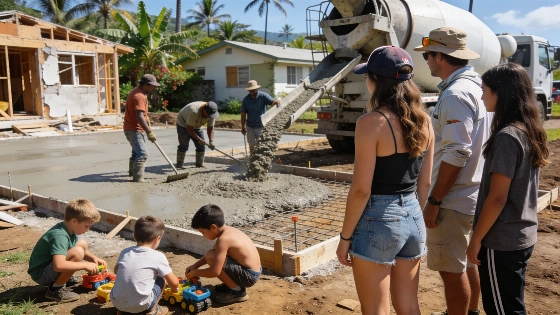
On a hot May morning in Lahaina, the Burke family gathered as a construction crew poured the cement foundation for their new home. This milestone came nearly three years after the 2023 wildfires destroyed their previous house and forced them, along with thousands of others, to leave. For Mikey Burke, seeing the foundation set marked the first real step toward recovery after years of uncertainty, health problems, and upheaval in their community.
The wildfires that swept through Lahaina on August 8, 2023, left widespread destruction and displaced many families, including the Burkes. The family of six spent months moving between temporary places before settling into a small rental. While handling insurance claims and the logistics of rebuilding, they also dealt with ongoing health issues. Their children faced mental health challenges, and both parents had elevated levels of heavy metals detected in their systems.
Health and Community Support in the Aftermath
Health resources became essential for the Burkes. At the Lahaina Comprehensive Health Center, Mikey Burke and her children received therapy and support through the Maui Wildfire Exposure Study (MauiWES), a University of Hawai'i project tracking health effects from wildfire exposure. The study found signs of post-traumatic stress disorder in the Burke twins, which led to therapy and participation in a weekly video gaming group led by therapist Chris Knightsbridge. These sessions helped the boys' mental health scores return to a normal range after a year of regular involvement.
Yet the future of MauiWES was in doubt as funding issues threatened its continuation. Organizers held a final event to collect survivors' health data, concerned it might be the last chance to track the community's ongoing needs. Mikey Burke voiced frustration at the possibility of losing this resource, stressing the need to monitor long-term health impacts for families like hers.
Community organizations stepped in as well. Noelani Ahia, founder of Maui Medic Healers Hui, offered a mix of Traditional Chinese Medicine and Hawaiian healing at the health center. She described the ongoing trauma as "colonial inflammation," referring to the compounded stress and historical injustices affecting Native Hawaiian families. For many, including the Burkes, these sessions provided rare relief amid constant challenges.
Rebuilding and Local Advocacy
Alongside her family's recovery, Mikey Burke became an advocate for local control and community rebuilding. She helped start the Lahaina Community Land Trust, which aims to keep land in local hands and focus on residents' needs during reconstruction. The family's journey included ongoing disputes over insurance, building materials, and access to mental health care as emergency funding for therapy approached its end.
As the new home's foundation took shape, the Burkes' children explored the construction site, reconnected with neighborhood friends, and began to regain a sense of normal life. Their resilience showed in these moments, even as the wider community continued to deal with the disaster's aftermath. Recovery efforts in Lahaina have brought expanded wildfire preparedness and interagency coordination. The Honolulu Fire Department reported that Battalion Chief Keith Ito, a 28-year veteran, led strategic planning and mitigation projects as Program Manager of the Wildland Urban Interface Working Group after the disaster. According to the department, these efforts focused on strengthening wildland fire preparedness and building community resilience through partnerships with local, state, and nongovernmental organizations (Honolulu Fire Department announcement). Of the more than 2,200 structures lost in the fires, just over 300 had been rebuilt three years later, showing how slow recovery has been.
For more on wildfire risks and community responses in the region, see this earlier report.
Research and Funding for Long-Term Health
Efforts to keep health monitoring and support for survivors moving forward gained traction as researchers Ruben Juarez and Alika Maunakea secured new funding for an expanded initiative called HO'ĀLA-Maui. This program, supported by grants from the National Institutes of Health and Maui County, plans to combine health screening, care navigation, and community outreach across the island. The researchers aim for a model based on Mauli Ola, a Hawaiian concept linking physical, mental, social, and environmental well-being.
With new grants totaling millions of dollars, the team will study the long-term effects of wildfire exposure and legacy pollutants on lung and heart health, as well as children's health outcomes. These efforts connect Maui's experience to broader national research on disaster recovery and environmental health, including collaborations with teams studying 9/11 responders and water contamination in Flint, Michigan. The need for ongoing research into wildfire-related health impacts is also reflected in federally registered studies such as HAIQU (Hospital AIr QUality), which is listed on ClinicalTrials.gov with an estimated completion date of September 30, 2029 (ClinicalTrials.gov study record).
As the Burkes and their neighbors keep rebuilding, the intersection of health, community, and environmental justice remains central to Lahaina's recovery. The foundation poured in May stands as a sign of progress and the long road ahead for families affected by the wildfires.